
Home Office Deduction Guide

7 min read
On this page
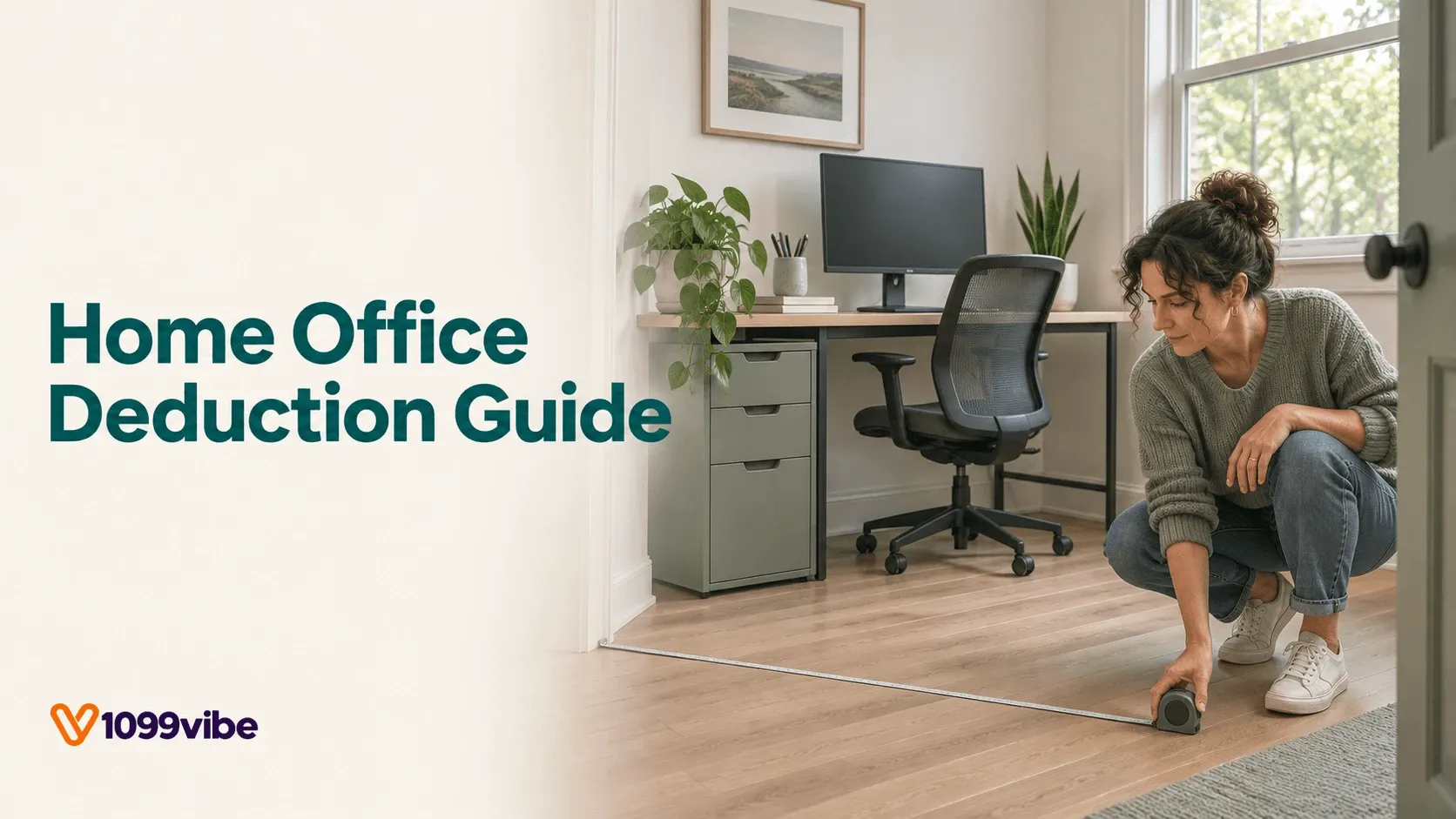
If you’re self-employed and use part of your home exclusively for work, you qualify for the home office deduction. The IRS offers two ways to calculate it: a simplified $5-per-square-foot method (up to 300 square feet) or actual expenses on Form 8829; this deduction can be used by both homeowners and renters. Employees working a traditional W-2 from home aren’t eligible, so this one is for your 1099 side.
Do You Qualify for the Home Office Deduction?
You qualify for this deduction if you use part of your home, or a separate structure on your property, exclusively and regularly as your main place of business. The IRS says you can claim the deduction only if you use that portion of the home exclusively and regularly for business purposes, and the Small Business Administration agrees.
“Exclusive use” means that corner is for work and nothing else. A desk in a spare bedroom where nobody sleeps? Good. The dining table where your kids also do homework? That one doesn’t pass the test. The space doesn’t have to be a whole room, but it must be a defined area that stays work-only.
“Regular use” means you work there on an ongoing basis. Twice a year doesn’t count. Most days or most weeks do.
“Principal place of business” trips 1099 professionals up when the bulk of the work happens elsewhere. If you run the administrative side of your work at home (booking, invoicing, editing, bookkeeping) and you have no other office, your home space can still qualify. That’s often true for real estate agents who show houses all day and do listings and paperwork at home.
Rideshare and delivery drivers usually don’t qualify. Your car isn’t your home office, and a laptop on the couch between shifts won’t meet the exclusive-use test. If you also run a storage area at home that holds only business gear or inventory, that area can count toward your space.
Can Remote W-2 Employees Claim It?
No, traditional employees can’t claim this expense. Miscellaneous itemized deductions for employee business expenses were eliminated for tax years after 2017, so remote work from a W-2 job doesn’t get you a write-off.
If you have a W-2 job and 1099 work on the side, only the self-employed side supports the deduction. The desk must be for freelance, creator, or agent work, and the deduction is limited by that income, not your paycheck.
How to Measure Your Home Office Square Footage
Measure the work area, then divide it by your home’s total square footage. That gives you your business-use percentage, which the IRS uses under the regular method to determine what share of your home costs count. Costs that apply only to the office itself are deducted in full.
Here are a few steps that you can do on your phone in ten minutes:
- Measure the length and width of your work area and multiply them. A 10-foot by 12-foot room is 120 square feet.
- Add any storage space used only for business, like a closet that holds only your camera gear, props, or inventory.
- Find your home’s total square footage. Check your lease, your property records, or an old listing.
- Divide your workspace by the total and keep that number with your records.
Don’t count space you share. Half the living room because you film there sometimes wouldn’t count, and neither does the hallway you walk through to get to the desk.
Simplified Method vs. Actual Expenses
The simplified method pays a flat rate per square foot. The actual expense method uses your real home costs times your business-use percentage. Same office, two very different amounts of paperwork.
| Simplified method | Actual expenses | |
|---|---|---|
| What you track | Square footage only | Rent or mortgage interest, utilities, insurance, repairs and maintenance, property taxes, plus depreciation if you own |
| Best for | Small spaces, light recordkeeping | Bigger spaces, higher rent or lots of home costs |
| Ceiling | $5 per square foot, up to 300 square feet ($1,500 max) | No flat cap, but limited by your business income |
| Depreciation | None to deduct or recapture later | Owners depreciate their share of the home |
The IRS lists the costs that may count under the regular method: mortgage interest, insurance, utilities, repairs, maintenance, depreciation, and rent. Costs for the office itself, like painting that one room, come off in full. Renters use rent the same way owners use mortgage interest: your business-use share of what you paid.
One nice thing about the simplified route: there’s no home depreciation deduction and no recapture of depreciation for the years you use it. That means fewer moving parts when you sell.
Here, actual expenses win by a lot, but you’d need the lease and the bills. The SBA describes the same $5 per square foot allowance and the $1,500 ceiling, so think of the simplified option as a floor, not a goal.
You choose a method by using it on your original return for that year, and you can’t change it for that same year.
What If Your Office Loses Money?
Your home office deduction can’t exceed the gross income from the business use of your home minus your other business expenses. A slow year can shrink it to zero.
Don’t take it as a penalty, because it’s not. It just means the deduction can’t create a loss on its own, so a $2,000 home office in a year you cleared $800 gets trimmed.
How to Claim It on Your Return
Your 1099 income and costs go on Schedule C for self-employment income and expenses. If you use actual expenses, the deduction is calculated on Form 8829 and carried over. If you use the simplified method, you skip that form and enter the amount directly.
Keep your measurements, some photos of the space, and the bills behind every number. Shoeboxing a year of utility statements in March is how good deductions get dropped, which is why 1099vibe tracks home costs and other Schedule C deductions as you go.
Home Office Examples by How You Earn
Freelancer: A spare bedroom with a desk, monitor, and filing bin, used only for client work. Measure the room, use rent and utilities, and you’re done.
Creator: A filming and editing corner plus a closet that holds only lights, props, and your backup camera. Both areas can count, as long as the family doesn’t use them too. Check out our creators page for additional ideas about your gear write-offs.
Real estate agent: A home office where you do listings, contracts, and client calls between showings. Not having your own brokerage desk usually helps, since the home space becomes where the business side happens.
FAQ
Does claiming a home office raise my audit risk?
Claiming a space you actually qualify for is a normal deduction, not a red flag. The IRS has published transparent rules. Measure honestly, skip the shared spaces, and keep records.
Can I deduct my rent if I rent an apartment?
Yes, you can. The IRS lists rent among the home office costs under the regular method. You deduct your business-use share, so a 10% office means 10% of your rent.
What exactly can I deduct with the actual expense method?
Your business-use share of mortgage interest, rent, insurance, utilities, repairs, maintenance, property taxes, and depreciation if you own. Costs that apply only to the office come off in full, since you use them 100% for your operations.
Can I switch between the simplified and actual methods?
You can choose a different method in a later year, but not for a year you’ve already filed using one. The choice is locked by the method you used on that original return.
Measure It Once, Keep the Bills
Once you have a measured space and a folder of saved bills, most of the work is done. Whether the room qualifies and which method saves you more depends on your numbers, and a tax expert can confirm both before you file. Real tax professionals are behind the guidance at 1099vibe.
Want to see what your workspace and other costs might be worth? You can calculate your tax savings with our free tool, then start a 15-day free trial. After that, it’s $19.99/month; cancel anytime.
1099vibe Tax Team
The 1099vibe Tax Team creates educational content to help freelancers, gig workers, and independent contractors understand self-employment income, business expenses, tax deductions, and tax preparation. The team translates complex topics into practical steps independent earners can take throughout the year. Tax content is reviewed by a tax professional for accuracy and clarity.