
LLC vs. S Corp for 1099 Earners

7 min read
On this page
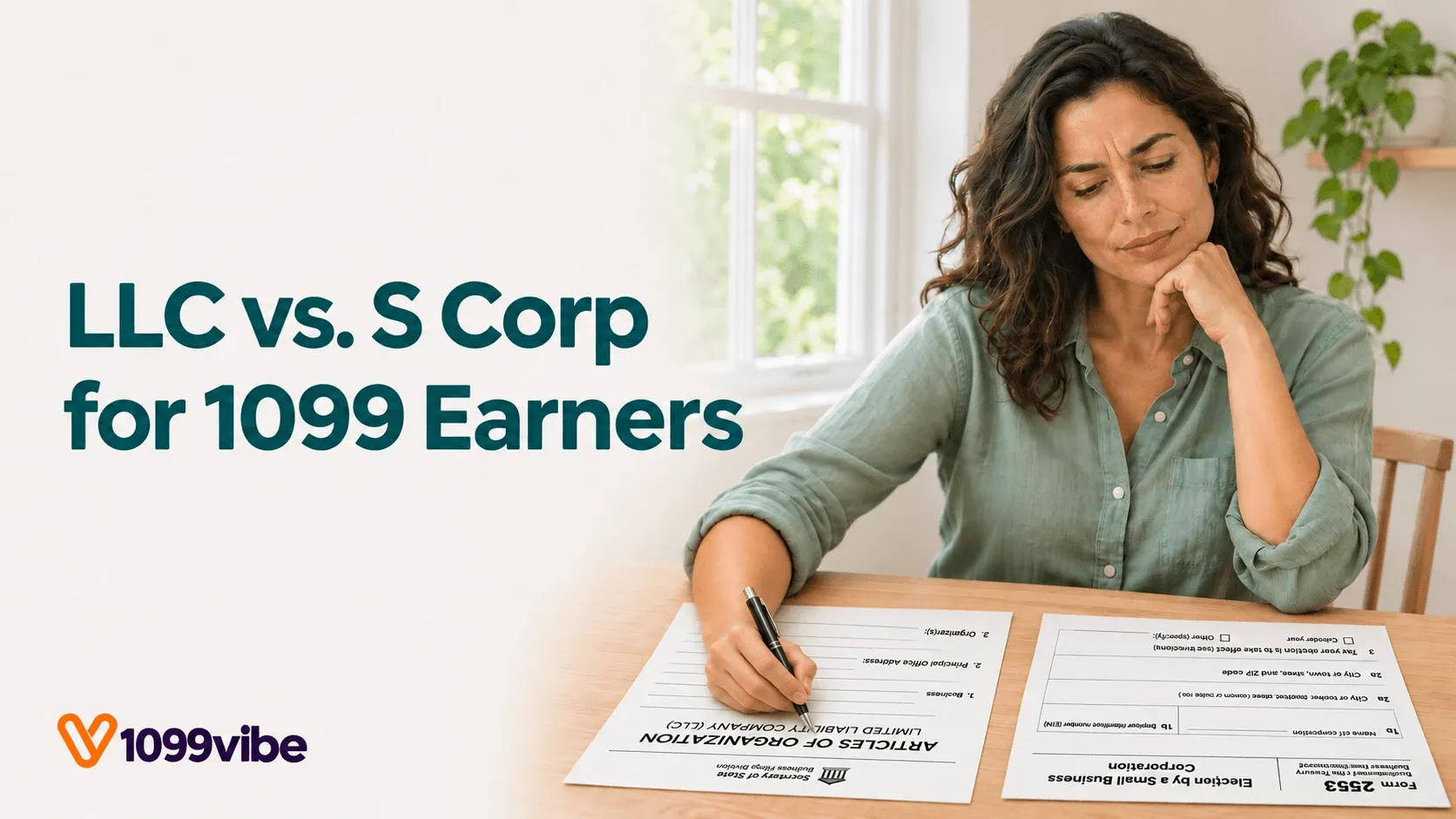
While a default sole proprietorship is fine to start with, as your business grows and matures, you’ll likely start looking at other entities. A limited liability company (LLC) is a legal structure that generally protects your personal assets, and an S corp is a tax election you can add on top of it to reduce the 15.3% self-employment tax. They’re not two versions of the same thing. For most part-time 1099 earners, neither one is the first move.
This article is for drivers, freelancers, creators, real estate agents, and NIL athletes who are tired of reading posts written for people with a payroll department.
What Is an LLC, and Do You Actually Need One?
An LLC is a legal structure that separates your personal assets from your 1099 business. According to the U.S. Small Business Administration, LLCs protect you from personal liability in most instances, so your car, your house, and your savings generally aren’t at risk if the LLC faces a lawsuit or bankruptcy.
Here’s where the confusion starts: an LLC doesn’t change your taxes on its own. A single-member LLC is treated as a “disregarded entity” for income tax purposes, meaning your income and expenses land on your personal return just like they did as a sole proprietor. An LLC with at least two members is classified as a partnership by default, unless it files Form 8832 to be treated as a corporation.
Either way, self-employment tax still shows up and can snowball the more you earn. The SBA notes that LLC members are considered self-employed and owe self-employment tax that funds Social Security and Medicare. The IRS says the same about LLC members who file partnership returns: they generally pay self-employment tax on their share of earnings.
To form one, you file your articles of organization with your state, pay a filing fee, and usually draft an operating agreement spelling out who owns what. Ownership rules, liability, taxes, and filing requirements vary by state, so your cost and paperwork depend on where you live.
What Is an S Corp, and How Is It Different?
An S corp isn’t a new kind of company. It’s a tax election, which means you’re asking the IRS to tax your existing LLC (or corporation) a different way.
S corps are pass-through entities. This means that profits, and some losses, pass straight through to the owners’ personal income without ever hitting corporate tax rates. That’s the opposite of double taxation, a C corporation problem: profits get taxed at the company level, then again when dividends hit shareholders’ personal returns.
Two filing details matter:
- You file for S corp status with the IRS (Form 2553). This is a separate process from registering with your state.
- The company files its own return, Form 1120-S, and each owner gets a Schedule K-1 showing their share of the income.
So your tax life goes from “one personal return” to “a business return plus your personal return.”
Where the LLC vs. S Corp Tax Savings Actually Come From
S corp savings come from splitting your money into two buckets: a paycheck and owner distributions. As a default LLC, self-employment tax applies to all of your profit. As an S corp, payroll taxes apply only to the salary you pay yourself, and the remaining profit can come out as distributions.
That salary has to be “reasonable,” meaning what someone would pay a person to do the work you do. The IRS expects a realistic number, not $8,000 on a six-figure profit.
Example (numbers are rounded for illustration): say your net profit is $100,000.
| Setup | Taxed for Social Security and Medicare | Approximate tax |
|---|---|---|
| LLC, default treatment | $100,000 of profit | $14,130 |
| LLC taxed as an S corp | $60,000 reasonable salary | $9,180 |
That’s a $4,950 difference on paper. It’s an estimate, and your real result depends on your state, your deductions, and your other income. Want a quick read on your own numbers? Our free 1099 tax calculator estimates federal, state, and self-employment tax in a couple of minutes.
One more wrinkle: the qualified business income deduction (up to 20% off your business profit) can shift the math in either direction, because paying yourself a salary lowers the profit that qualifies. This scenario can be addressed by a tax professional.
What Does S Corp Status Cost You in Real Life?
S corp status adds real work and real bills, and that’s what shrinks the $4,950 on paper. Here’s what you take on:
- Running payroll for yourself, with withholding and pay stubs, usually through a payroll service you pay monthly.
- Quarterly payroll filings and year-end W-2s.
- A separate business tax return (Form 1120-S), which costs more to prepare than a personal return.
- State fees and, in some states, a franchise tax or annual report. Taxes and filing requirements vary by state.
- Corporate formalities, including a separate business bank account and keeping personal and business money apart.
- Estimated taxes on your distributions, since no one is withholding on those.
If payroll, filings, and the extra return run you a few thousand dollars a year, they tend to erase the extra savings an S corp can provide.
When Should You Switch From an LLC to an S Corp?
The switch usually makes sense when your profit is steady, year-round and well above what you’d pay yourself as a salary, and you can handle payroll without losing sleep. Switching usually isn’t worth it when the money is lumpy, or the gig is part-time.
Signs it may be time:
- Your profit has been high for more than one full year, not one great season.
- The work is year-round, not seasonal.
- You’re already keeping clean books and a separate business account.
Signs to wait:
- It’s a side business or your first full year.
- Income swings hard from month to month.
- You also have a full-time W-2 job. Your day job may already cover a chunk of your Social Security tax for the year, so the election can add payroll costs without saving much.
How this plays out by segment: a real estate agent with steady commissions after splits and desk fees is the classic candidate, while a weekend DoorDash driver rarely is. A creator whose income triples during one brand-deal year and drops the next usually wants another year of data before moving forward with an election.
With 1099vibe, a tax expert looks at your numbers and tells you whether an LLC would actually lower your taxes. If it would, LLC setup is a separate one-time charge, not part of the standard monthly plan. We handle the paperwork and ensure you’re set up correctly from the start.
FAQ
Can an LLC be taxed as an S corp?
Yes, your LLC stays an LLC with your state and files Form 2553 with the IRS to be taxed as an S corp. The IRS notes that if a qualifying LLC elects S corporation treatment, it files Form 1120-S and S corporation rules apply.
At what income does switching to an S corp make sense?
There’s no magic number in the tax code, but some 1099 professionals switch once they regularly hit $60,000 to $80,000 annually. The practical test is whether your profit sits well above a reasonable salary for your work, steadily, by enough to cover payroll and the extra return, with room left over to make it worth it.
Does an S corp help if I have a full-time W-2 job plus 1099 work?
Often less than employees with side gigs expect. Your W-2 wages already contribute to Social Security and Medicare, so the savings on a smaller side income may not cover payroll costs.
Do I pay self-employment tax on S corp distributions?
No, self-employment tax doesn’t apply to S corp distributions, which is the whole point of the election. Your salary is still subject to payroll taxes, and it must be reasonable.
Do I need an LLC to write off my mileage and gear?
No, expenses count at their business-use share with records either way, whether you’re a sole proprietor or an LLC. Your contemporaneous mileage log still needs the date, purpose, and miles.
Keep More of What You Earn, Whichever Setup You Pick
Clean books make these decisions easier, because you can’t compare an LLC vs. an S corp without knowing your real profit. 1099vibe tracks your miles and expenses all year, with real tax professionals behind the guidance and a credentialed tax professional reviewing your return before it’s filed.
Start your 15-day free trial; then it’s $19.99/month. Cancel anytime.
1099vibe Tax Team
The 1099vibe Tax Team creates educational content to help freelancers, gig workers, and independent contractors understand self-employment income, business expenses, tax deductions, and tax preparation. The team translates complex topics into practical steps independent earners can take throughout the year. Tax content is reviewed by a tax professional for accuracy and clarity.